
Methodology & Scoring of our IQ Test
WorldIQTest is a non-verbal online reasoning assessment designed to provide an adult estimate of cognitive performance with reduced dependence on language, vocabulary, and formal education. It focuses on abstract, logical, numerical, and spatial reasoning while excluding verbal and language-based questions.
The test is an online estimate for personal insight. It is not a clinical IQ assessment, diagnostic tool, admissions test, employment test, or qualification for Mensa membership.
Why non-verbal questions?
Language-heavy questions can be influenced by vocabulary, educational experience, and familiarity with a specific test language. WorldIQTest uses visual and logic-based tasks so people can take the test in their preferred interface language without relying primarily on verbal knowledge.
Our goal is to make comparison more meaningful across different languages, educational experiences, and backgrounds. A person should not be disadvantaged simply because a word, school-based reference, or culturally familiar concept in a question is unfamiliar to them.
No assessment is completely culture-free. WorldIQTest is described as culture-fair because it is designed to reduce language bias, not eliminate every cultural, educational, economic, or test-condition effect.
What the test measures
| Reasoning domain | What it explores |
|---|---|
| Abstract reasoning | Identifying visual patterns, relationships, and rules in unfamiliar information. |
| Logical reasoning | Applying rules, drawing conclusions, and solving novel logic problems. |
| Numerical reasoning | Identifying number patterns and applying numerical logic. |
| Spatial reasoning | Understanding shapes, transformations, and spatial relationships. |
These domains are most closely related to fluid reasoning and related non-verbal cognitive abilities. The test does not measure creativity, emotional intelligence, personality, motivation, practical judgment, academic knowledge, or every ability assessed in a clinical psychological evaluation.
Explore the types of IQ questions we use.
Question design and difficulty
The 30-question test follows a progressive difficulty curve: it begins with more accessible tasks and gradually introduces more complex ones. This helps the assessment capture performance across a range of reasoning difficulty.
Questions are evaluated in group testing to understand their average accuracy rate and typical completion time. This information helps establish a baseline difficulty value for each item before it is included in scoring.
Norm-referenced weighted scoring
WorldIQTest uses norm-referenced weighted scoring. The test is not adaptive: every participant receives the same progressive question sequence. “Adaptive testing” would mean later questions change in response to earlier answers, which is not how this test works.
Your result considers three factors:
- Accuracy: the questions you answer correctly.
- Question difficulty: more difficult items carry different weight than easier items.
- Completion time: an efficiency signal considered alongside accuracy and difficulty. It is not a separate intelligence domain.
There is no strict time limit. However, unusually fast or slow completion can affect score quality and is considered in the scoring model. Faster, accurate answers may contribute differently from answers completed more slowly; speed alone does not determine a result.
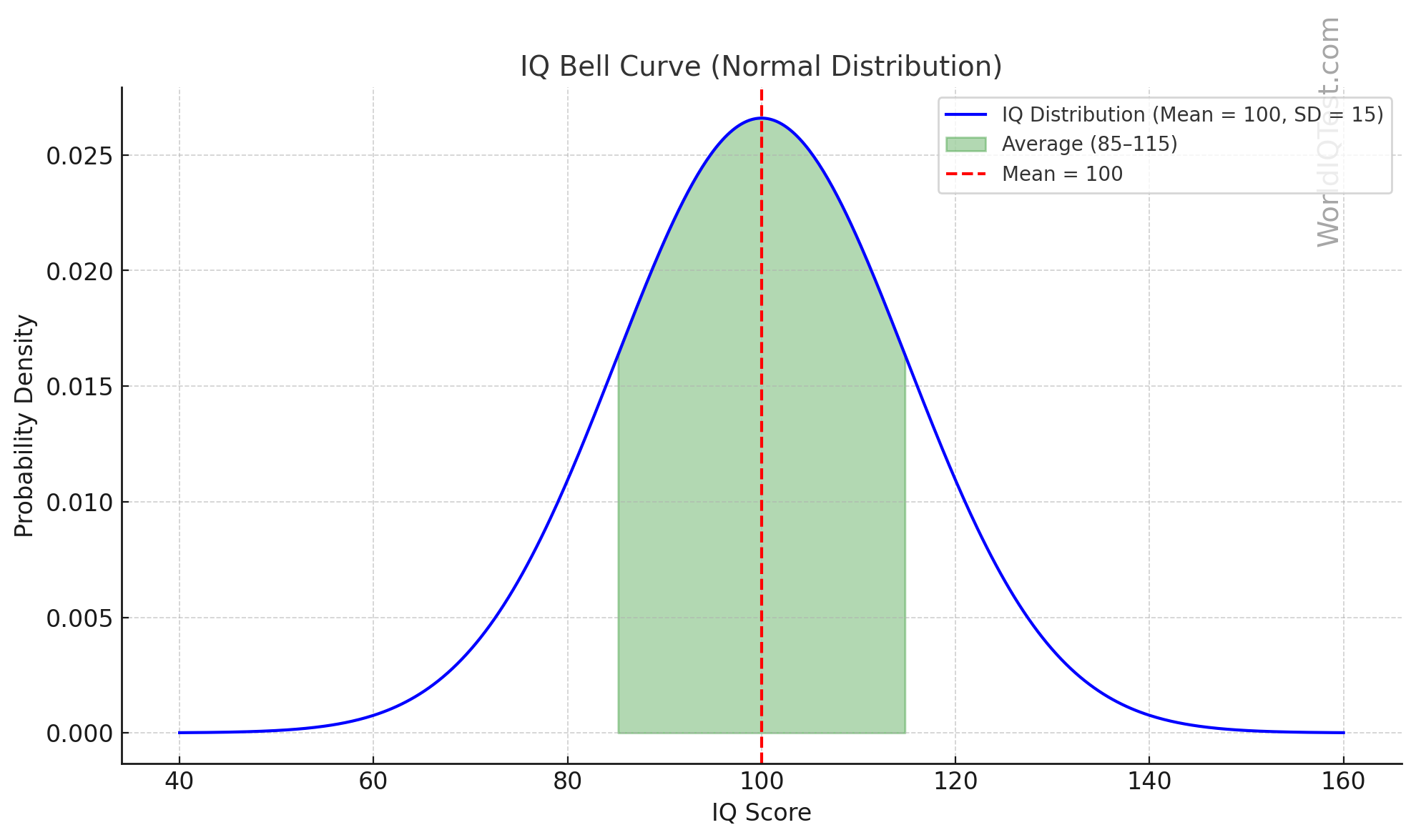
Results are compared with quality-filtered, first-attempt adult test data and reported on a standard IQ scale with an average of 100 and a standard deviation of 15. On this type of scale, scores nearer to 100 are more common, while scores farther from 100 are less common.
Adult norming and calibration
The initial adult norming study included 1,400 participants aged 18–65 from more than 25 countries. An initial 80-person item-screening phase was used to evaluate item clarity and filter unsuitable questions before final test construction.
Scoring is periodically reviewed using quality-filtered, first-attempt adult data. Repeat attempts do not contribute to norming or calibration because familiarity with questions can influence later performance.
Data quality
To protect score quality, WorldIQTest uses technical and behavioral integrity checks, completion-pattern review, and first-attempt rules to identify suspicious, duplicate, automated, incomplete, or low-quality sessions before including them in research and norming analyses.
These processes help improve the comparison sample, but they do not make an online assessment equivalent to a professionally supervised clinical evaluation.
Important limitations
Your score is a snapshot of your performance on this set of reasoning tasks at a particular time. Sleep, stress, anxiety, distractions, device conditions, language background, test familiarity, and other circumstances can influence an online result.
An IQ score does not determine your worth, potential, or future success. It does not capture the full range of abilities that matter in life, including creativity, relationships, emotional skills, character, motivation, practical judgment, health, opportunity, and lived experience.
Research and professional guidance
WorldIQTest is informed by established research on fluid reasoning, non-verbal assessment, and responsible technology-based testing. It is independent and is not affiliated with or endorsed by the sources below. These sources explain relevant principles; they do not independently validate WorldIQTest itself.
- Cattell (1978): Fluid and Crystallized Intelligence
- Condon & Revelle (2014): International Cognitive Ability Resource
- International Test Commission: Technology-Based Assessment Guidelines
- AERA, APA, and NCME: Standards for Educational and Psychological Testing
- Hebb and Cattell: Fluid and Crystallized Intelligence