
Interactive training
Choose your abstract reasoning challenge
Work through visual evidence one step at a time. Answers are scored locally, and every solution reveals the rule so that each attempt remains informative.
Visual matrix studio
Visual matrices
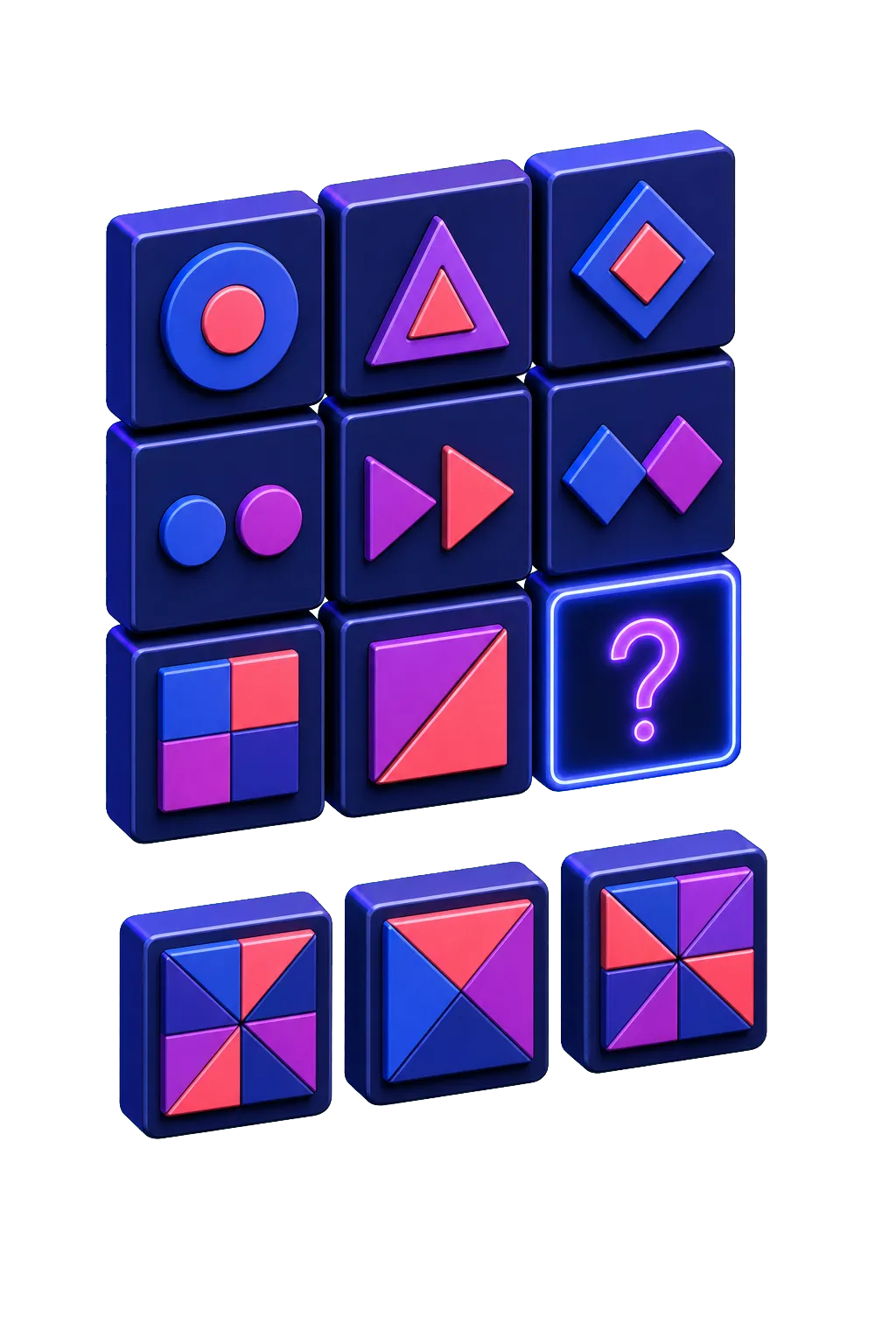
Complete a visual matrix by tracking changes in rotation, colour, quantity, fill or a combined rule.
- 10 generated questions per session
- Several visual rule families
Pattern boundary lab
Odd rules and continuations
Find the element that breaks the rule, or choose the next tile in a controlled visual progression.
- 5 generated questions per session
- Odd-one-out and continuation tasks
Session complete
A practical reasoning loop
How abstract reasoning practice works
The goal is to form a rule that explains every visible element, test it against the evidence, and reject a rule that only fits one detail.
Compare
Separate the visible features before deciding what changes.
Hypothesise
Describe the simplest rule that accounts for the evidence.
Test
Apply the rule to the missing position or the next visual state.
Review
Use the revealed rule to understand the solution and refine your approach.
Ready for a broader challenge?
Take the full IQ test
Use these skills in the full IQ test
These exercises focus on visual rules and deduction. The full World IQ Test also includes numerical, logical, abstract and spatial reasoning tasks.
What is abstract reasoning?
Abstract reasoning involves identifying relationships between visual details and using those relationships to reach a supported conclusion.
Matrix tasks encourage you to track several features—such as rotation, fill and quantity—without relying on a single cue.
What these exercises practise
- Separating visual features before comparing options
- Recognising repeated, alternating and combined rules
- Testing one rule against all available evidence
- Using visual constraints to reach a justified choice
Useful abstract reasoning strategies
- Check one visual feature at a time before combining them.
- Compare rows and columns, not only neighbouring tiles.
- Use elimination when an option breaks a confirmed condition.
- Test the rule against every visible example.
- Prefer the simplest rule that explains all available evidence.
How to use this training effectively
Before choosing an answer, name the features that change and the features that stay fixed. This brief pause makes your reasoning explicit and reduces impulsive choices.
When an answer is wrong, compare the displayed rule with your own idea rather than only noting the correct option. Progress here reflects performance in these exercise formats and is not a standalone IQ score.
Questions about practice
Abstract reasoning FAQ
What kinds of questions are included?
Sessions use visual matrices, odd-rule tasks and pattern continuations.
Are explanations provided?
Yes. After every answer, the rule or deduction is shown so you can review it immediately.
Where is my progress stored?
Completed and active sessions use localStorage in this browser. Clearing browser data removes the history.
Does this give an IQ score?
No. These exercises provide practice in a specific format and do not produce a standalone IQ score.