Interactive training
Choose your spatial challenge
Rotate an object in your mind or follow a cube net as it folds. Answers are scored locally, and every solution explains the relevant viewpoint or face relationship.
3D object studio
Mental rotation and block matching
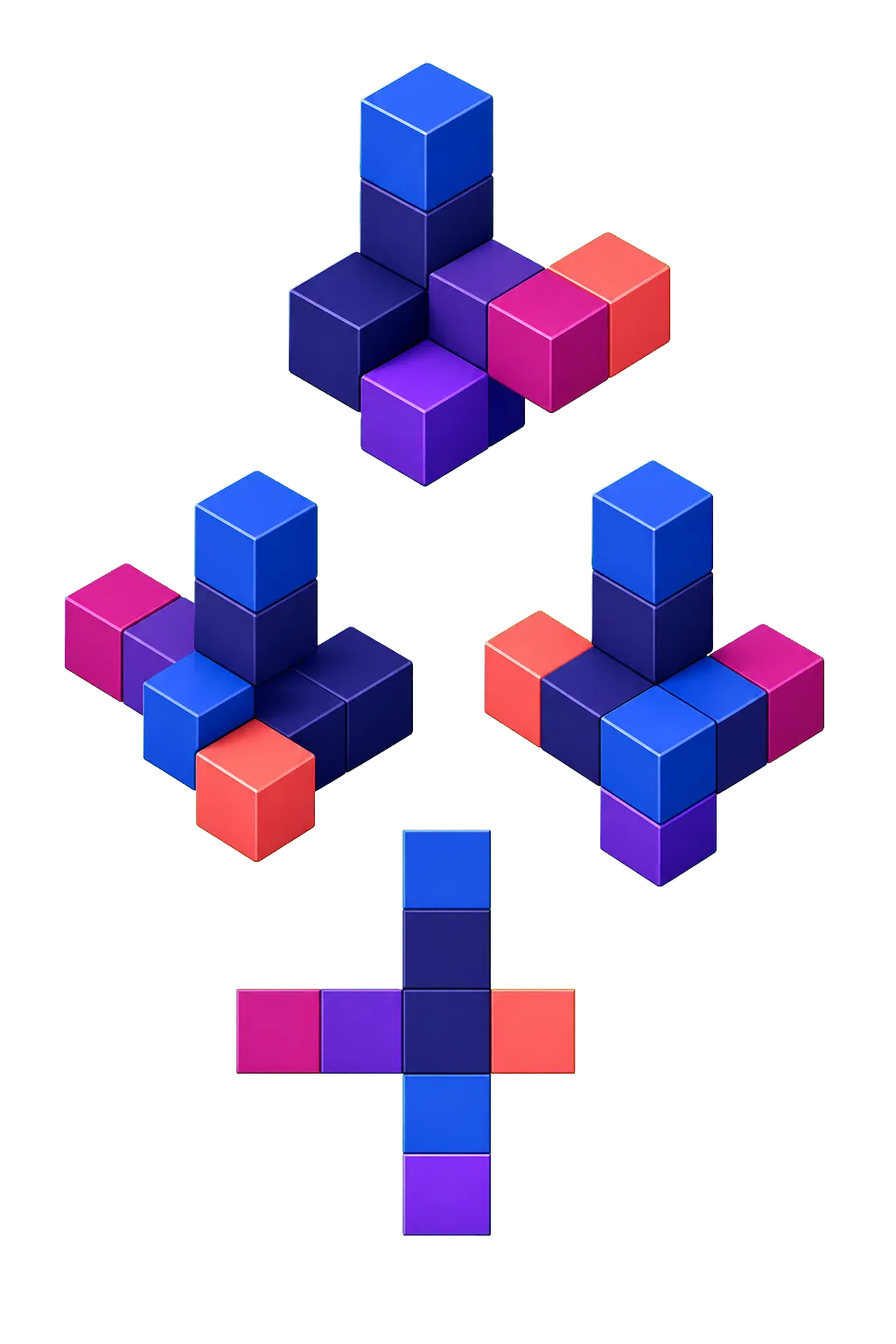
Match a 3D block sculpture to the same object seen from a different angle. Look for its structure, joined faces and distinctive corners rather than its screen orientation.
- 10 generated questions per session
- Different viewpoints and block arrangements
Cube net laboratory
Fold cube nets and find opposite faces
Visualise a flat cube net folding into a solid cube, then decide which marked faces meet or sit opposite each other.
- 5 generated questions per session
- Face adjacency and opposite-face rules
Session complete
A practical reasoning loop
How spatial awareness practice works
The aim is not to picture every movement perfectly. Fix one distinctive feature, track what stays connected as the view changes, and test your conclusion against the whole object.
Anchor
Choose a distinctive corner, stack or marked face to keep track of.
Rotate
Imagine the object turning while its joined blocks or faces stay connected.
Test
Compare the fixed feature and neighbouring parts with each answer option.
Review
Use the revealed view or folded cube to refine your approach.
Ready for a broader challenge?
Take the full IQ test
Use spatial insight in the full IQ test
These exercises focus on 3D views and cube nets. The full World IQ Test also includes numerical, logical and abstract reasoning tasks.
What is spatial reasoning?
Spatial reasoning is the ability to understand how objects relate in space and how they may look from another viewpoint. It supports tasks such as interpreting diagrams, maps and physical layouts.
The 3D matching exercise asks you to recognise the same block sculpture after rotation. Cube-net questions focus on how a flat arrangement becomes a solid cube and which faces can be opposite.
What these exercises practise
- Tracking a 3D object as its viewpoint changes
- Recognising stable connections between blocks
- Visualising a flat cube net folding into a solid
- Testing face relationships against every visible clue
Useful spatial strategies
- Use a distinctive corner or marked face as an anchor.
- Count connected blocks instead of relying on silhouette alone.
- Check which features would remain adjacent after rotation.
- For cube nets, fold neighbouring faces from one base face.
- Remember that opposite faces cannot share an edge.
How to use this training effectively
Do not rotate the entire shape at once. Start with a distinctive block or face, then trace its neighbours. For cube nets, imagine folding one face up at a time from a chosen base.
When an answer is wrong, compare the displayed explanation with the feature you tracked. Progress here reflects performance in these exercise formats and is not a standalone IQ score.
Questions about practice
Spatial reasoning FAQ
What kinds of questions are included?
Sessions include mental rotation of 3D block sculptures and folding cube nets to identify opposite faces.
Do I need to rotate a real object?
No. The exercises are designed for mental visualisation, but you can take time to trace the structure carefully.
Are explanations provided?
Yes. After every answer, the relevant rotation or folded-face relationship is shown for review.
Where is my progress stored?
Completed and active sessions use localStorage in this browser. Clearing browser data removes the history.